
The Rise of Animation in Corporate Communications
Static PDFs and slide decks are losing the battle for attention. Animation has become the format of choice for complex messages that need to land with diverse, time-poor audiences.
Discuss This With Our TeamPrish Group
Creative Studio Practice
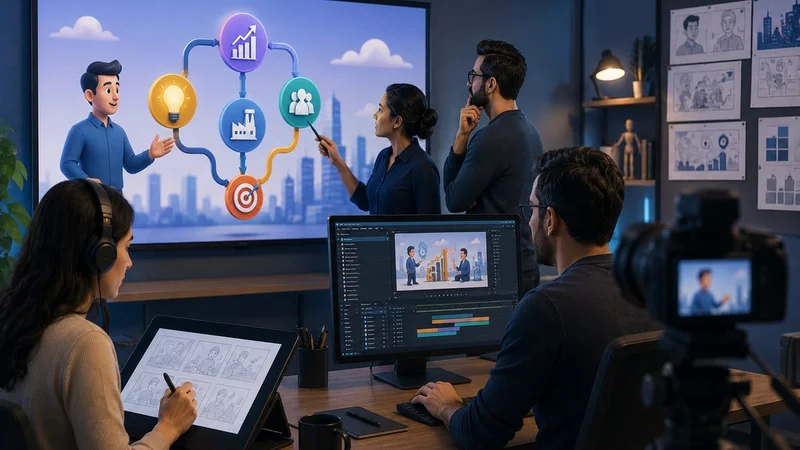
Corporate communications have always faced a fundamental tension: the need to communicate complex, nuanced information to audiences who are simultaneously time-poor, attention-divided, and visually sophisticated. Animation has emerged as the most effective medium for resolving that tension. The quality bar for what organisations produce has risen dramatically.
Why Animation Works Where Other Formats Struggle
The cognitive science is straightforward: humans process visual information 60,000 times faster than text. More importantly, animated visuals with accompanying audio engage two sensory channels simultaneously, improving information retention significantly compared to text-only or static visual formats.
For corporate communications specifically, animation offers three structural advantages:
Complexity made accessible: multi-step processes, abstract concepts, organisational structures, and data-heavy narratives are all substantially clearer when animated than when described in prose or shown as static diagrams.
Language-agnostic communication: for organisations operating across multiple geographies and linguistic backgrounds, well-designed animation can communicate the same message effectively regardless of the viewer's primary language. This is particularly relevant for UAE-based organisations with multinational workforces.
Consistency at scale: a short animated explainer delivers the same message, in the same way, with the same emphasis, to the thousandth viewer as to the first. Human-delivered briefings do not.
Where Organisations Are Using Animation Effectively
Investor and stakeholder communications
Annual reports, investor updates, and strategy presentations animated as short films are increasingly common among listed companies in the region. The combination of visual clarity and professional production quality signals organisational sophistication.
Employee onboarding and policy communication
Animated explainers for onboarding, compliance training, and policy updates consistently outperform text-based equivalents on comprehension and completion metrics. Employees watch a two-minute animation; they do not read a four-page PDF.
Product and service explainers
For technology products, financial services, and B2B offerings with complex value propositions, animation bridges the gap between how a product works and why a customer should care. A well-crafted 90-second explainer often does more for pipeline conversion than extensive written collateral.
Internal process documentation
Process animations for quality management, compliance procedures, and operational workflows are increasingly used as the primary reference material for frontline staff, replacing paper-based SOPs that go unread.
The Quality Bar Has Changed
Five years ago, a mid-quality 2D animation was competitive in most corporate contexts. The bar has moved substantially. Audiences have been educated by the quality of content they consume in their personal lives, and they apply those standards when evaluating corporate content.
This does not mean every corporate animation needs a cinematic production budget. It does mean that low-effort, template-based animation that was acceptable as recently as 2022 now reflects poorly on the organisation that produces it.
The distinguishing factors in high-quality corporate animation are subtle but immediately felt: character of motion (ease curves and timing), typographic quality, colour discipline, sound design, and the quality of the underlying script. These elements are visible even to viewers who cannot articulate why one animation feels more credible than another.
Planning an Animation Project
The most common mistake in commissioning animation is beginning with visual style before defining communication objectives. The right sequence is:
- Define the audience and what you need them to understand, feel, or do after watching
- Write and approve the script (this is 60% of the project)
- Define visual style based on brand and audience context
- Produce storyboard for structural approval
- Animate and refine
Organisations that attempt to reverse-engineer a script from visual references consistently produce animation that looks good and communicates poorly.


