
AR and VR in Healthcare: Transforming Patient Care Across the Middle East
Immersive technology is moving from pilot project to core clinical infrastructure. Here is how AR and VR are being applied in healthcare settings across the region.
Discuss This With Our TeamPrish Group
Immersive Tech Practice
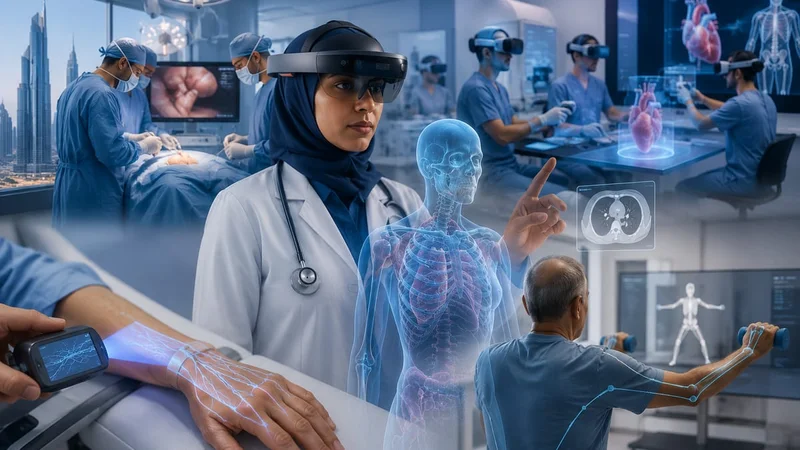
The healthcare sector has historically been cautious in adopting emerging technology, for good reason. But augmented and virtual reality have crossed a threshold of reliability and cost-accessibility that is making them serious candidates for clinical deployment, not just innovation showcase projects.
Clinical Training Without Clinical Risk
The most immediate and compelling application of VR in healthcare is training. Medical procedures have always required trainees to practise on patients, with all the inherent risk that entails. VR changes this equation entirely.
Surgical simulation using VR allows trainees to perform procedures hundreds of times in a controlled environment before their first live case. Studies consistently show measurable improvement in procedural competence and confidence scores among trainees who complete VR simulation programmes alongside traditional training.
Beyond surgical training, VR is being deployed for emergency medicine simulation, clinical communication skills training, and mental health therapeutic applications, each with a growing evidence base supporting its effectiveness.
AR in Clinical Settings
Augmented reality applications in clinical environments are more nascent but advancing quickly. The applications attracting the most serious development investment include:
Surgical navigation overlays: using AR headsets to overlay patient imaging data onto the surgical field in real time, improving precision for complex procedures.
Vein visualisation: handheld AR devices that project vein maps onto the skin surface, reducing failed venipuncture attempts and patient discomfort, particularly in paediatric and oncology settings.
Rehabilitation guidance: AR overlays guiding physiotherapy exercises at home, enabling higher-quality home-based rehabilitation and reducing the frequency of costly in-person sessions.
The UAE Healthcare Context
Healthcare in the UAE is undergoing its own significant digital transformation driven by regulatory reform, population health demands, and the ambition to become a global medical tourism destination. The Dubai Health Authority and Department of Health Abu Dhabi have both invested in innovation frameworks that create a more permissive environment for technology pilots than many other healthcare jurisdictions.
This creates an unusual opportunity: healthcare providers in the UAE can move faster with immersive technology adoption than their counterparts in more heavily regulated markets, and the competitive benefits of doing so in patient outcomes and institutional reputation are substantial.
What Deployment Actually Looks Like
Healthcare organisations considering AR or VR should approach deployment realistically:
Pilot scope first: identify a single high-value, measurable use case. Surgical simulation for a specific procedure type, VR for anxiety reduction in a specific patient cohort, or AR-guided rehabilitation for a specific condition. Measure rigorously.
Clinical validation matters: immersive technology in a clinical context needs the same evidence base as any clinical intervention. Partner with your clinical governance team from day one, not after the technology is built.
Hardware selection is contextual: what works for a training centre is not necessarily what works in a theatre or at the bedside. Hardware selection should follow use case definition, not precede it.
The organisations that are building sustainable competitive advantage in healthcare through immersive technology are not the ones with the most exciting pilots. They are the ones that moved from pilot to clinical standard operating procedure.


